Repudiation of Motor Insurance Claims and the Role of Crash Investigation
Given South Africa’s persistently high collision rate, operating a motor vehicle without insurance exposes drivers to severe financial and legal risk. Motor insurance is often regarded as an unwelcome but necessary expense, yet its core purpose is risk transfer: protecting the insured against losses that would otherwise be financially ruinous. That protection, however, is not unconditional.
Motor insurance is a contract. In exchange for indemnity, the insured undertakes specific contractual obligations, including duties of care, disclosure, and loss prevention. Insurers are entitled to limit their exposure to foreseeable and lawful risks. Losses arising from material breaches—such as reckless conduct, intoxication, or deliberate non-compliance—may legitimately fall outside cover.
When a claim is submitted, insurers typically investigate the circumstances of the collision to determine causation, contributing factors, and whether the insured complied with policy conditions. Where an alleged breach is identified, repudiation may follow. The legitimacy of such repudiation depends not only on policy wording, but on the quality, neutrality, and scientific defensibility of the investigation relied upon.
Understanding the Risk of Unjustified Repudiation
A long-standing legal maxim holds that where facts are properly established, the law will follow. Crash investigation exists to establish those facts. However, investigators appointed and remunerated by insurers are not immune to structural bias. While most operate professionally, the risk of confirmation bias—conscious or otherwise—cannot be ignored. For this reason, findings relied upon for repudiation should be scrutinised critically and, where appropriate, tested against independent expert analysis.
This issue has become increasingly pronounced in speed-based repudiations, where insurers allege that the insured failed to take reasonable care by driving at an excessive speed, thereby breaching a contractual duty to mitigate risk or prevent loss.
A Growing Pattern in Speed-Based Repudiations
Over many years of practice in crash investigation, reconstruction, and expert testimony, a clear shift has emerged. Historically, repudiations were largely confined to cases involving gross negligence or intoxication. More recently, repudiation on the basis of alleged excessive speed has become commonplace—even in cases where no independent enforcement evidence exists.
The pattern is consistent. A collision occurs. A claim is lodged. The insurer appoints an investigator or “expert.” A report follows, concluding that the insured was travelling at excessive speed, often relying on a single mathematical formula. The claim is repudiated on the basis that the insured failed to exercise due care and thereby materially increased the risk.
In many cases, insured drivers insist they were not speeding. They are then placed in the position of disproving an expert conclusion generated by a party appointed by the insurer, often months after the collision and after critical evidence has degraded or disappeared.
Procedural Imbalance and the Ombudsman Process

South African policyholders may approach the Ombudsman for Short-Term Insurance (OSTI) when a claim is repudiated. While this process is intended to be accessible, it presents practical challenges.
Once the insurer submits its response—typically including an expert report—the complainant is afforded limited time to reply. In practice, this may require the insured to appoint an independent expert, arrange a scene inspection, examine the vehicle, review the insurer’s report, and produce a technical response within days. Extensions are rarely generous.
This creates a material imbalance. The insurer has had months to investigate; the insured may have days to respond meaningfully. If the insured initiates formal litigation, the OSTI generally withdraws from the matter, leaving the complainant to pursue costly and protracted court proceedings.
The Problem with Simplistic Speed Calculations
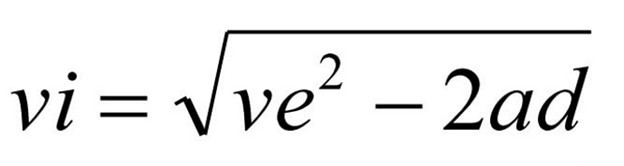
A recurring concern in repudiation cases is the repeated use of a single basic motion equation to determine vehicle speed, irrespective of collision complexity. This approach is fundamentally flawed when applied outside narrow conditions.
The equation commonly relied upon is designed to calculate initial velocity where:
the end velocity is known,
the deceleration rate is known, and
the distance over which deceleration occurred is accurately established.
In real-world collisions, these conditions are rarely satisfied without qualification.
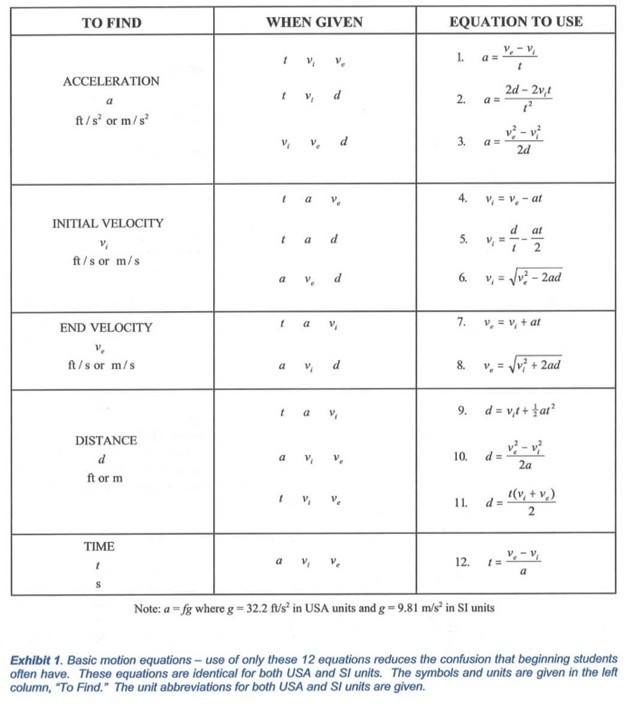
Authoritative reconstruction texts, including those used in international training programmes, explicitly caution that basic motion equations are introductory tools. They are not substitutes for comprehensive analysis. They require accurate input values and careful consideration of assumptions. When those assumptions are not met, results become unreliable.

Key Variables Commonly Overlooked
Distance of Deceleration
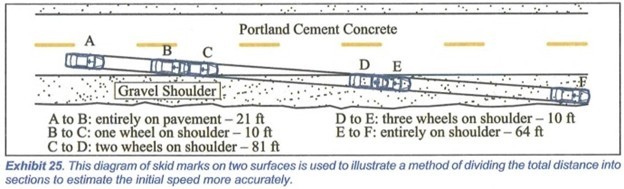
Distance must be measured along the vehicle’s true path of motion. Where braking, skidding, yaw, rollover, or post-impact travel occurs, the distance cannot be treated as a single continuous value without segmentation.
Multiple Surfaces
When a vehicle decelerates across different surfaces—tar, gravel, grass, mud—each surface has a different frictional characteristic. Treating the entire movement as if it occurred on a single surface materially distorts results.
Wheel Locking and Braking State
Deceleration depends on how many wheels were locked, whether ABS was active, and whether the driver was braking, coasting, or accelerating. Without evidence, assumptions must favour uncertainty, not worst-case outcomes.
Drag Factor Variability
Drag factor is not a fixed constant. It varies with surface type, surface condition (wet or dry), tyre condition, vehicle speed, and direction of travel. International research and engineering literature consistently present drag factors as ranges, not single values.
Collision Dynamics
If a vehicle strikes an object, rolls over, rotates, or sustains structural damage during deceleration, energy is dissipated through mechanisms not accounted for in simple sliding-distance formulas. In such cases, speed cannot be reliably calculated using a single equation in isolation.
When a Single-Formula Approach Is Inappropriate
Speed calculations based solely on basic motion equations become unreliable where any of the following apply:
the vehicle travelled over multiple surfaces,
there was impact with another vehicle or fixed object,
the vehicle did not slide to a natural stop,
the vehicle was rotating, yawing, or rolling,
braking behaviour cannot be established,
tyre marks cannot be conclusively linked to the vehicle or specific wheels.
In such cases, the method is incompatible with the event being analysed. Conclusions drawn under those circumstances are not merely debatable; they are scientifically unsound.
Legal and Contractual Implications
In South African law, insurers bear the onus of proving a material breach when repudiating a claim. A finding of negligence or recklessness must be supported by credible evidence. Expert opinion that is speculative, methodologically flawed, or unsupported by primary data is vulnerable to challenge.
Comparable principles apply in United States insurance litigation, where courts increasingly scrutinise expert methodology under admissibility standards that require reliability, transparency, and proper application of scientific principles.
Practical Guidance for Policyholders
Where repudiation is threatened or has occurred:
Request the full expert report relied upon by the insurer.
Do not assume the conclusions are correct or unassailable.
Consider appointing an independent expert as early as possible, ideally before evidence is lost.
Preserve the vehicle and document the scene if feasible.
If approaching the OSTI, obtain expert assistance in preparing the submission.
Understand that while expert fees involve cost, the absence of independent evidence places the insured at a severe disadvantage.

Litigation remains an option, but it is slow, expensive, and procedurally demanding. The OSTI process, while imperfect, often resolves matters more quickly—provided the insured is properly supported.
Concluding Observations
A troubling trend has emerged in which speed has become the default justification for motor claim repudiation. When complex collision dynamics are reduced to a single formula and unsupported assumptions, the risk of injustice is real.
Proper crash investigation is not about producing convenient answers. It is about disciplined evidence collection, transparent reasoning, and adherence to accepted scientific principles. Where those standards are not met, repudiation may be neither fair nor lawful.
Independent forensic analysis remains one of the most effective safeguards available to insured motorists facing repudiation based on questionable expert findings.